


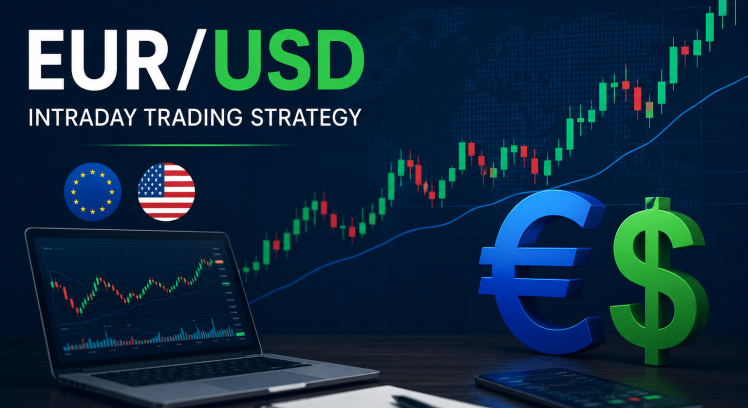




EUR/USD Intraday Trading Strategy: How to Trade the World’s Most Popular Currency Pair
The EUR/USD is the most actively traded currency pair in the global foreign exchange market, accounting for nearly a quarter of all daily Forex transactions. Its high liquidity, tight spreads, and predictable price behavior make it the preferred choice for both beginner and experienced day traders.
However, many traders enter the market without a structured intraday strategy. They rely on emotions, random indicators, or social media signals, which often leads to inconsistent results.
This guide explains a professional EUR/USD intraday trading strategy, including market sessions, technical indicators, risk management, entry rules, exit techniques, and common mistakes to avoid.
What Is Intraday Trading?
Intraday trading (also known as day trading) involves opening and closing positions within the same trading day. Unlike swing traders who hold trades for days or weeks, intraday traders capitalize on short-term price movements.
The main objectives are:
- Capture quick market opportunities
- Avoid overnight swap charges
- Reduce exposure to unexpected news events
- Trade multiple setups in one day
Most EUR/USD intraday trades last anywhere from 5 minutes to several hours.
Why Trade EUR/USD?
The EUR/USD pair offers several advantages over other currency pairs.
1. Highest Liquidity
Millions of EUR/USD transactions occur every day, allowing traders to enter and exit positions with minimal slippage.
2. Low Trading Costs
Most brokers offer the lowest spreads on EUR/USD, making it cost-effective for frequent trading.
3. Strong Technical Behavior
EUR/USD often respects technical levels such as:
- Support
- Resistance
- Trendlines
- Moving averages
- Fibonacci retracements
This makes technical analysis more reliable.
4. High Volatility During Key Sessions
Price movement increases significantly during:
- London Session
- New York Session
- London-New York Overlap
These periods provide the best intraday trading opportunities.
Best Time to Trade EUR/USD
Timing plays a major role in intraday success.
| Trading Session | Activity Level | Best For |
|---|---|---|
| Asian Session | Low | Range Trading |
| London Session | High | Trend Trading |
| New York Session | High | Breakouts |
| London-New York Overlap | Very High | Maximum Volatility |
Ideal Trading Window
The best trading opportunities usually occur during the London-New York overlap, when both European and U.S. markets are active simultaneously.
During this period:
- Higher volume
- Strong momentum
- More reliable breakouts
- Better liquidity
Market Conditions Before Entering a Trade
Before placing any trade, evaluate the market.
Ask yourself:
- Is the market trending?
- Is it ranging?
- Are major economic events scheduled today?
- Is volatility increasing or decreasing?
- Is the spread normal?
Avoid trading immediately before high-impact news releases unless you specialize in news trading.
Timeframes for EUR/USD Intraday Trading
Most professional traders combine multiple timeframes.
Higher Timeframe (Trend)
- 1 Hour (H1)
- 4 Hour (H4)
Purpose:
Determine overall market direction.
Execution Timeframe
- 15 Minutes
- 5 Minutes
Purpose:
Find precise entries.
Entry Timeframe
- 1 Minute (optional)
Used only for fine-tuning entries.
Best Indicators for EUR/USD Intraday Trading
Using too many indicators creates confusion.
A simple setup often performs better.
1. 20 EMA
The 20-period Exponential Moving Average identifies short-term momentum.
Price above EMA:
Bullish
Price below EMA:
Bearish
2. 50 EMA
The 50 EMA confirms the overall trend.
When:
20 EMA > 50 EMA
Market is generally bullish.
When:
20 EMA < 50 EMA
Market is generally bearish.
3. Relative Strength Index (RSI)
Recommended setting:
14 Period
Levels:
- Above 70 = Overbought
- Below 30 = Oversold
- Around 50 = Neutral
RSI is most effective when used alongside price action rather than as a standalone signal.
4. Average True Range (ATR)
ATR helps determine:
- Stop-loss distance
- Market volatility
- Profit targets
Higher ATR indicates greater price movement.
5. Volume (If Available)
Increasing volume often confirms:
- Breakouts
- Trend continuation
- Reversal strength
EUR/USD Trend-Following Strategy
This is one of the most reliable intraday strategies.
Buy Setup
Conditions:
- Price above 20 EMA
- 20 EMA above 50 EMA
- Higher highs and higher lows
- RSI above 50
- Price pulls back toward EMA
Entry:
Buy after a bullish confirmation candle.
Stop Loss:
Below the recent swing low.
Take Profit:
At least 1:2 Risk-Reward Ratio.
Sell Setup
Conditions:
- Price below 20 EMA
- 20 EMA below 50 EMA
- Lower highs and lower lows
- RSI below 50
- Price retraces upward
Entry:
Sell after bearish confirmation.
Stop Loss:
Above recent swing high.
Take Profit:
Minimum 1:2 Risk-Reward.
Breakout Strategy
EUR/USD frequently consolidates before major market sessions.
Identify
- Asian session range
- Support and resistance
- Triangle patterns
- Rectangles
Buy Breakout
Wait for:
- Strong bullish candle
- Volume increase
- Candle closes above resistance
Avoid entering before the candle closes to reduce false breakouts.
Sell Breakout
Wait for:
- Bearish candle
- Close below support
- Increased momentum
Pullback Trading Strategy
Many professional traders avoid chasing price.
Instead, they wait for pullbacks.
In Uptrend
- Price rallies
- Pulls back to EMA
- Forms bullish candlestick
- Resume buying
In Downtrend
- Price declines
- Retraces upward
- Forms bearish signal
- Resume selling
Pullbacks often offer lower-risk entries.
Candlestick Patterns That Improve Accuracy
Watch for confirmation patterns.
Bullish
- Hammer
- Bullish Engulfing
- Morning Star
Bearish
- Shooting Star
- Bearish Engulfing
- Evening Star
Candlestick patterns become more reliable near support, resistance, or moving averages.
Risk Management Rules
No trading strategy succeeds without proper money management.
Professional traders focus on protecting capital.
Risk Per Trade
Limit risk to:
1–2% of account balance
Example:
Account = $5,000
Maximum risk = $50–$100
Risk-Reward Ratio
Aim for:
- 1:2
- 1:3
Avoid trades with poor reward potential.
Daily Loss Limit
Stop trading after reaching:
- 3 consecutive losing trades
- 3–5% daily drawdown
This prevents emotional decision-making.
Economic News to Monitor
EUR/USD is highly sensitive to macroeconomic releases.
Important events include:
- U.S. Non-Farm Payrolls (NFP)
- Consumer Price Index (CPI)
- Federal Reserve interest rate decisions
- European Central Bank (ECB) announcements
- Eurozone inflation reports
- GDP releases
- PMI data
- FOMC Meeting Minutes
Many traders avoid opening new positions shortly before these events because volatility can increase dramatically.
Common Mistakes Traders Make
Overtrading
Taking too many trades reduces discipline and increases transaction costs.
Ignoring the Trend
Trading against the dominant market direction lowers the probability of success.
Chasing Price
Entering after a strong move often results in poor entry prices.
Moving Stop Loss
Expanding a stop-loss to avoid taking a loss usually increases risk rather than improving outcomes.
Risking Too Much
Using excessive leverage or risking a large portion of your account on a single trade can quickly deplete trading capital.
Sample EUR/USD Intraday Trading Plan
| Step | Action |
|---|---|
| Market Trend | Determine trend on H1 |
| Key Levels | Mark support and resistance |
| News Check | Review economic calendar |
| Indicator Confirmation | EMA + RSI |
| Entry | Wait for confirmation candle |
| Stop Loss | Below/Above swing point |
| Target | Minimum 1:2 Risk-Reward |
| Risk | Maximum 1% per trade |
| Exit | TP, SL, or end of trading session |
Building Consistency in Intraday Trading
Success in EUR/USD intraday trading comes from executing a repeatable process rather than predicting every market move. Keep a trading journal that records the setup, entry, exit, reasoning, and outcome for each trade. Reviewing this data regularly helps identify recurring mistakes and refine your strategy over time.
It’s also important to test any strategy on historical data and in a demo account before risking real capital. A method that performs well across different market conditions is more likely to remain effective than one optimized for a single period.
Final Thoughts
A profitable EUR/USD intraday trading strategy combines trend analysis, disciplined entries, effective risk management, and patience. No strategy wins every trade, but following a well-defined trading plan can improve consistency and help limit losses.
Remember that trading success is measured over a series of trades—not by the outcome of any single position. Focus on executing your strategy with discipline, managing risk carefully, and continually reviewing your performance. Over time, this process is more likely to produce sustainable results than chasing quick profits.