




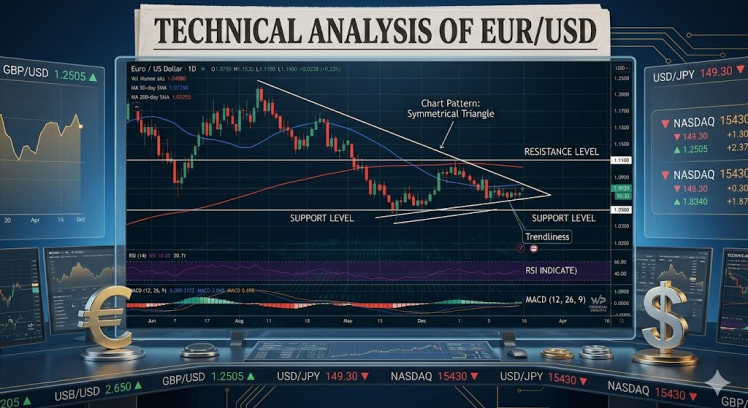




The EUR/USD currency pair remains one of the most actively traded instruments in the global forex market, attracting traders and investors seeking opportunities based on economic developments, central bank policies, and technical price action. Recent market movements have highlighted the importance of key support and resistance zones as traders assess the next potential direction for the pair.
EUR/USD Market Overview
EUR/USD has experienced notable volatility in recent trading sessions as market participants react to economic data releases from both the Eurozone and the United States. The pair continues to fluctuate within a well-defined trading range, with buyers and sellers competing for control near significant technical levels.
As uncertainty surrounding interest rates, inflation, and economic growth persists, traders are increasingly relying on technical analysis to identify potential entry and exit points.
Current Technical Structure
From a technical perspective, EUR/USD remains supported above several important price zones. The pair is trading near key moving averages, suggesting that market sentiment remains balanced while traders await a clear breakout signal.
Price action indicates that a decisive move above resistance could strengthen bullish momentum, while a breakdown below support may open the door for further downside pressure.
Key Support Levels
Primary Support Zone
The nearest support area continues to attract buying interest and may provide a foundation for potential upward movement. Traders often watch this zone closely for signs of bullish reversal patterns.
Secondary Support Level
If bearish pressure increases, the next support area could become an important target. A break below this level may signal weakening market sentiment and increase selling activity.
Long-Term Support Area
This broader support region remains critical for maintaining the pair’s overall structure. Sustained trading below this zone could indicate a shift in market direction.
Key Resistance Levels
Immediate Resistance
The first resistance zone represents a significant hurdle for buyers. A successful breakout above this area could encourage additional bullish momentum.
Psychological Resistance Level
Psychological price levels frequently influence trader behavior and market sentiment. Breaking above these levels often attracts increased trading volume and market participation.
Major Resistance Zone
A move beyond this resistance region could signal stronger bullish momentum and potentially lead to an extended upward trend.
Technical Indicators Analysis
Relative Strength Index (RSI)
The RSI remains within neutral territory, suggesting that EUR/USD is not currently in overbought or oversold conditions. This leaves room for movement in either direction depending on upcoming market catalysts.
Moving Average Convergence Divergence (MACD)
The MACD indicator continues to provide mixed signals, reflecting the ongoing battle between buyers and sellers. Traders may look for future crossovers to confirm trend direction.
Moving Averages
Short-term and long-term moving averages remain important reference points for market participants. Price action above these averages generally supports a bullish bias, while trading below them may favor bearish sentiment.
Fundamental Factors Influencing EUR/USD
Several economic and geopolitical developments continue to shape EUR/USD price movements:
- European Central Bank (ECB) policy decisions
- U.S. Federal Reserve monetary policy announcements
- Inflation reports from the Eurozone and the United States
- Employment data, including Non-Farm Payrolls (NFP)
- GDP growth figures
- Global risk sentiment and geopolitical events
These factors can significantly impact volatility and influence the pair’s movement around key technical levels.
Bullish Scenario
If EUR/USD breaks above immediate resistance levels, buyers could gain greater control of the market. Strong Eurozone economic data or a weaker U.S. Dollar may provide additional support for further gains.
Bearish Scenario
A failure to hold above key support zones could increase downward pressure on the pair. Stronger U.S. economic performance or renewed demand for the U.S. Dollar may encourage sellers to target lower price levels.
Conclusion
EUR/USD remains at an important technical juncture, with support and resistance levels continuing to guide market sentiment. Traders should monitor both technical indicators and major economic developments to identify potential trading opportunities. Combining sound technical analysis with effective risk management remains essential when navigating the ever-changing forex market.