



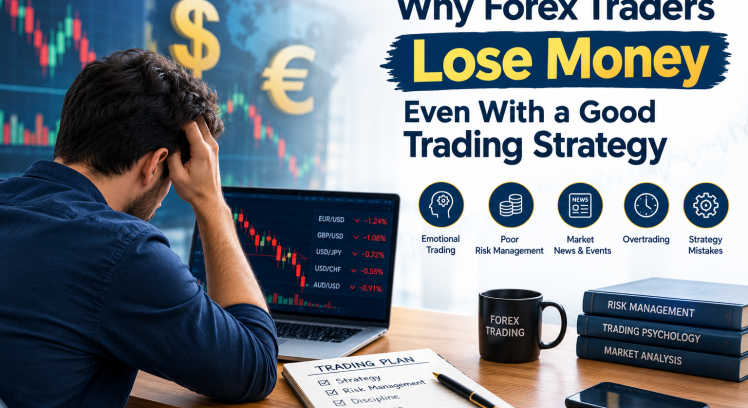




Why Forex Traders Lose Money Even With a Good Trading Strategy
A profitable strategy does not automatically create a profitable trader. Discover how execution, risk management, psychology, leverage and market conditions can turn a potentially good trading system into a losing one.
Risk Management
Psychology
Trading Discipline
The uncomfortable truth:
A good Forex strategy does not automatically make someone a profitable trader. A strategy can have a statistical edge and still lose money when it is poorly executed, incorrectly sized, overleveraged or used in the wrong market conditions.
A common belief among new Forex traders is that losses happen because they have not yet found the right trading strategy. So they search for another indicator, another system, another signal provider or another automated trading tool.
The search can continue indefinitely. The reality is that trading performance depends on much more than the entry signal. A more complete framework is:
What Makes a Forex Strategy “Good”?
A good strategy is not necessarily one that wins 80% of its trades. It is not necessarily the strategy with the most indicators or the most complicated rules.
A serious strategy should have a measurable and repeatable edge. Over a sufficiently large sample of trades, it should demonstrate a favorable relationship between winning trades, losing trades and risk.
Win Rate
How frequently the strategy produces winning trades.
Expectancy
The average expected outcome across many trades.
Drawdown
How much the strategy can decline during losing periods.
1. The Trader Does Not Actually Follow the Strategy
This is one of the most common problems. A trader may have a defined system, but they do not consistently execute it.
Strategy says: Enter only after confirmation.
Trader does: Enters early.
Strategy says: Risk 1%.
Trader does: Risks 3%.
Strategy says: Respect the stop-loss.
Trader does: Moves it when price approaches.
At that point, the trader is no longer testing the original strategy.
They have created a different system through inconsistent execution.
2. Position Sizing Can Destroy a Profitable Strategy
A strategy can have a genuine statistical edge and still destroy an account when the trader risks too much on individual trades.
Risk management should therefore be designed around the strategy’s expected losing streak and drawdown—not simply around how much money the trader wants to make.
3. Traders Confuse Leverage With Opportunity
Leverage allows traders to control larger positions relative to their available margin. It does not mean traders should use the maximum leverage offered by a broker.
4. Traders Change Their Strategy During a Losing Streak
Every legitimate strategy experiences losing periods. A losing streak does not automatically mean that a strategy has stopped working.
Loss Loss Win Loss Loss Loss Win
Beginners often respond by changing indicators, timeframes, currency pairs, stop-loss rules or entry conditions. This prevents them from ever collecting enough data to properly evaluate the original system.
5. The Strategy Is Used in the Wrong Market Conditions
No strategy performs equally well in every market environment.
A trend-following system can behave very differently during a sideways market, while a range strategy may struggle during a strong directional move.
Trending Market
Directional movement with sustained momentum.
Range Market
Price repeatedly moves between defined areas.
High Volatility
Large and rapid price movements.
Low Volatility
Smaller and slower price movements.
6. Traders Enter Trades That Are Not Actually Setups
Watching charts for hours can create the illusion that there is always an opportunity.
A small price movement becomes a breakout. A candle becomes a reversal. A random movement becomes a trading signal.
Activity is not the same as productivity.
If a strategy produces three valid setups per week, taking fifteen trades
does not create five times more opportunity.
7. Traders Let Winning Trades Become Losing Trades
A trader enters a position and price moves in the expected direction. Instead of following the predefined exit plan, the trader decides to hold longer because the position “might go further.”
Price reverses. The profitable position reaches breakeven and eventually becomes a loss.
The market did not necessarily cause the problem. The trader abandoned the exit rules.
8. Traders Move Stop-Losses When They Are Wrong
A stop-loss exists because the original trading idea can be wrong. Moving it farther away simply because the trader does not want to accept the loss changes the original risk calculation.
9. Traders Risk More After Losing
Revenge trading begins when the trader stops evaluating opportunities objectively and starts trying to recover previous losses.
10. Traders Focus on Win Rate Instead of Expectancy
A high win rate sounds impressive, but it does not automatically mean a strategy is profitable.
| Strategy | Win Rate | Average Win | Average Loss | Potential Result |
|---|---|---|---|---|
| Strategy A | 70% | $20 | $100 | Can lose money |
| Strategy B | 40% | $150 | $50 | Can be profitable |
11. Trading Costs Can Turn a Small Edge Into a Loss
A strategy may look profitable before transaction costs but become unprofitable after spreads, commissions, financing charges and slippage are included.
12. Traders Ignore Correlation
Holding several currency positions does not necessarily mean you have diversified your risk. Multiple positions may have similar exposure to the same underlying currency movement.
Portfolio risk matters.
Risk should be considered across the entire portfolio rather than looking only at each trade individually.
13. Traders Trade With Money They Cannot Afford to Lose
When trading capital is needed for essential expenses, psychological pressure can become overwhelming.
Every losing trade starts to feel like a financial emergency. This can lead to moving stops, increasing risk, closing positions prematurely and taking revenge trades.
14. Traders Expect a Strategy to Work Every Day
Markets do not provide identical opportunities every day.
A strategy may experience profitable periods, losing periods and periods where there are very few valid setups.
15. Traders Confuse a Good Trade With a Winning Trade
A trade can follow every rule and still lose money. Conversely, a trader can ignore every rule and accidentally make money.
Loss
Rules followed, risk controlled and trade executed correctly.
Profit
Rules ignored, excessive risk and lucky outcome.
How to Find Out What Is Actually Causing Your Losses
Before replacing your strategy, review your recent trades and separate strategy performance from execution mistakes.
A Simple Framework for Understanding Trading Performance
This is a conceptual framework—not a mathematical profit formula.
How Traders Can Improve Their Results
01. Reduce Risk
Lower exposure while diagnosing performance problems.
02. Stop Strategy Hopping
Give a properly defined system enough data to evaluate.
03. Journal Every Trade
Record setup, execution, risk and outcome.
04. Separate Strategy From Execution
Determine whether losses came from the system or from mistakes.
05. Analyze Losing Streaks
Determine whether losing sequences are normal for the strategy.
06. Measure Performance
Evaluate the system over a meaningful sample of trades.
Your Strategy Is Only One Part of Your Trading System
The goal of Forex trading is not to find a strategy that never loses. That strategy does not exist. The real objective is to develop a process where losses are expected, risk is controlled, decisions are repeatable,
and a genuine trading edge has enough opportunity to express itself.
Risk Disclaimer:
Forex trading involves significant risk and may not be suitable for all investors. Past performance does not guarantee future results. The information provided in this article is for educational and informational purposes only and should not be considered investment, financial or trading advice.