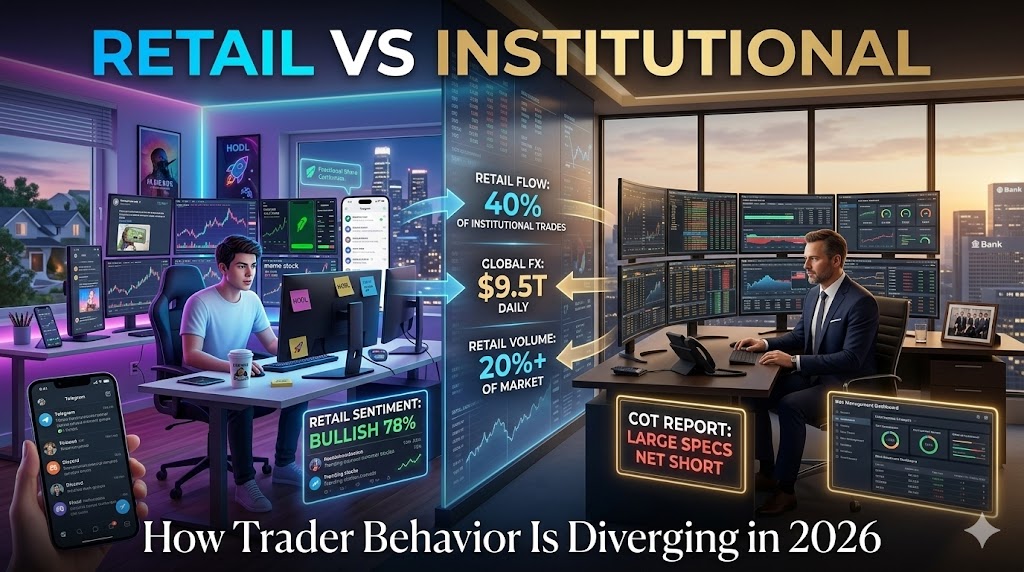





Retail vs Institutional:
How Trader Behavior Is Diverging in 2026
The Big Picture: Two Worlds, One Market
In 2026, the gap between retail and institutional trading has never been wider—yet they remain deeply connected. A recent survey by Horizon Trading Solutions revealed that nearly two-thirds of institutional traders now report that at least 40% of their total trading activity involves retail flow, either directly or indirectly. Only 1% said retail activity accounts for less than 20% of their trades [citation:2].
This integration creates a fascinating dynamic: retail traders increasingly influence institutional execution strategies, while institutional behavior shapes the liquidity environment retail traders operate in [citation:2][citation:3].
Retail vs Institutional: Key Differences in 2026
| Factor | Retail Traders | Institutional Traders |
|---|---|---|
| Primary Motivation | Speculation, short-term gains | Hedging, asset allocation, risk management [citation:3] |
| Time Horizon | Minutes to weeks | Months to years |
| Information Sources | Social media, news, forums | Proprietary research, data feeds, COT reports [citation:3] |
| Leverage Usage | High (often excessive) | Moderate, risk-controlled |
| Market Impact | Short-term volatility spikes | Long-term trend formation |
| Behavioral Pattern | Herd mentality, emotional | Systematic, rules-based |
🏦 How Institutions Behave in 2026
Institutional traders—banks, hedge funds, asset managers—are driven by balance-sheet hedging, asset allocation shifts, and risk premia harvesting. Their trades are large, deliberate, and designed to minimize market impact [citation:3].
Key Institutional Trends in 2026:
Major liquidity providers increasingly match client flows internally rather than stepping into external markets. This compresses observable spreads but can elevate systemic sensitivity to internal risk models [citation:3].
With higher volatility regimes, institutions are moving from simple forward hedges to option overlays and structured approaches that balance cost efficiency against tail risk [citation:3].
Institutional adoption of crypto and multi-asset platforms is rising, with digital assets increasingly woven into portfolios as risk overlays and non-correlated assets [citation:3].
📱 How Retail Traders Behave in 2026
Retail traders are more empowered than ever. Commission-free trading, AI-driven platforms, and fractional shares have democratized access. But with power comes predictable behavioral patterns [citation:7].
Key Retail Trends in 2026:
Academic research published in The Journal of Financial Economics reveals a sobering truth: retail investors’ long-term accumulated trades predict returns opposite to their intended direction. They buy stocks with low expected returns and sell stocks with high expected returns [citation:8].
In 2025, retail trading volume accounted for over 20% of U.S. market activity, a stark increase from pre-ZIRP levels. During meme stock events, this surged to 16% of total market activity [citation:7].
Interestingly, while long-term retail positioning underperforms, short-term trade surges actually predict positive returns. This suggests retail traders have some informational advantage in very short windows—perhaps from social media sentiment or rapid reaction to news [citation:8].
🔄 The Feedback Loop: How Retail Shapes Institutional Behavior
Here’s where it gets interesting: retail trading isn’t just a sideshow anymore. It’s actively reshaping institutional execution strategy [citation:2].
Survey Says
Nearly 75% of institutional respondents said rising retail participation has required adjustments to their execution strategy. Almost one-third said it has fundamentally changed the way they trade [citation:2].
Extended Hours
25% of institutions pointed to extended trading hours as the retail-driven initiative with greatest impact on their operations [citation:2].
🔗 The ‘InstiTail’ Phenomenon
One of 2026’s most significant trends is the rise of “InstiTail” trading—retail traders gaining access to tools and concepts once reserved for institutions. Many brokers now offer institutional-grade analytics, smart order routing, and even direct market access to retail clients [citation:5].
What’s Changing:
- Execution quality – Retail platforms now advertise measurable performance metrics and slippage protection [citation:5]
- AI-powered analytics – Once institutional-only, now available to retail via platforms like MetaTrader 5 AI Copilot [citation:7]
- Securities lending – UK retail investors can now earn passive income by lending holdings, previously institutional territory [citation:9]
📊 What the COT Report Reveals
The CFTC’s Commitment of Traders (COT) report offers a window into how institutional sentiment differs from retail narratives. Large speculators and money managers often have longer time horizons and hedging motivations that diverge sharply from short-term retail positioning [citation:3].
“Institutional positioning tends to dampen volatility over longer horizons, while retail positioning can amplify short-term swings.” — Investing.com, 2026 [citation:3]
⚠️ Key Risk Themes for 2026
📊 Leverage Fragility
Excessive leverage at retail venues can create shallow liquidity pockets—particularly on under-regulated platforms. Leverage risk remains central in 2026 [citation:3].
⚖️ Regulatory Fragmentation
ESMA and FCA scrutiny continues, with focus on investor protection, transparent execution, and leverage disclosures. Brokers must adapt [citation:3].
🔄 Retail Offsetting Institutional Selling
Recent market action shows retail buying offsetting institutional selling, creating unusual dynamics. While households hold record equity levels, institutional caution persists [citation:6].
💡 Where Retail Actually Wins
Despite the grim long-term statistics, retail traders have genuine advantages in certain areas:
- Agility – Retail traders can enter and exit positions instantly, without moving markets
- Niche opportunities – Small-cap stocks, micro futures, and emerging market currencies where institutional liquidity is thin [citation:9]
- Sentiment detection – Being part of the retail community provides early signals on crowd behavior
- Short-term surges – Research confirms weekly retail trade imbalances predict positive returns [citation:8]
📚 What Academic Research Says
A comprehensive 2026 study published in The Journal of Financial Economics examined nine types of market participants across 130 stock return anomalies. The findings are striking [citation:8]:
| Participant Type | Performance |
|---|---|
| Corporate Insiders | Best informed – share buybacks signal value |
| Short Sellers | Highly informed – use public data effectively |
| Institutional Investors | Neutral – no robust return prediction ability |
| Retail Investors | Poor long-term – buy low expected return stocks |
The paradox: while retail long-term trades underperform, weekly trade surges actually predict positive returns. The lesson? Overtrading hurts; strategic short-term moves can work [citation:8].
🎯 What This Means for Your Trading
1. Don’t fight the trend
If institutions are selling and retail is buying, understand which side has structural staying power. Institutional flows shape long-term trends [citation:6].
2. Use the COT report
Monitor large speculator positioning. When retail and institutional positioning diverge sharply, the resolution often favors institutions [citation:3].
3. Don’t overtrade
The research is clear: long-term accumulated retail trades underperform. Overtrading is the enemy [citation:8].
4. Leverage retail advantages
Use your agility for short-term opportunities. Watch for sentiment extremes and social media signals that institutions miss [citation:7].
“Retail trading is not just a feature of financial markets – it’s actively shaping infrastructure and liquidity dynamics for all market participants.”
— Sylvain Thieullent, CEO Horizon Trading Solutions [citation:2]
Final Thoughts
The divergence between retail and institutional trading in 2026 isn’t just a curiosity—it’s the central dynamic shaping modern markets. Retail traders bring volume, volatility, and democratization. Institutions bring scale, stability, and structural staying power.
Academic research confirms what many suspected: retail traders struggle with long-term positioning but can excel in short-term tactical trades. Meanwhile, institutions increasingly adapt their execution strategies to accommodate—and profit from—retail flow [citation:2][citation:8].
The winning approach? Understand both sides. Track institutional positioning through COT reports. Monitor retail sentiment through social platforms. Use your agility for short-term edges while respecting the structural forces that drive long-term trends.
In 2026’s two-speed market, the best traders don’t pick sides—they understand both.
⚡ Know the difference. Trade accordingly. ⚡
© 2026 · For traders who want to understand the game