








- The Pound Sterling falls to near 1.3400 against the US Dollar as the US reaches a trade agreement with the EU.
- Investors expect the Fed to leave interest rates steady on Wednesday.
- The BoE is expected to cut interest rates next week.
The Pound Sterling (GBP) drops to near 1.3400 against the US Dollar (USD) at the start of the week. The GBP/USD pair falls as the US Dollar attracts bids after the announcement of a trade framework between the United States (US) and the European Union (EU).
The US Dollar Index (DXY), which tracks the Greenback’s value against six major currencies, rises to near 97.90 at the time of writing.
Over the weekend, US President Donald Trump announced a trade agreement with the EU, which states that the baseline tariffs on imports from Brussels will be 15%, half of what Trump threatened in the mid of the month.
The US-EU tariff deal has led to a sharp increase in demand for riskier assets. However, risk-sensitive currencies struggle to capitalize on the cheerful market mood as the agreement has also improved the outlook for the US Dollar.
Trade agreement confirmation between both economies on both sides of the Atlantic has undermined uncertainty surrounding the August 1 tariff deadline, which was keeping a lid over the US Dollar’s upside. The US-EU trade pact confirmation indicates that Washington has closed deals with several of its key trading partners, except Canada and Mexico.
Meanwhile, investors await US-China trade talks in Stockholm to discuss the tariff truce, which will start from Monday. According to the South China Morning Post (SCMP), Washington and Beijing are expected to extend their tariff truce for 90 days, which will expire on August 12.
Daily digest market movers: Pound Sterling to be influenced by BoE’s interest rate expectations
- The Pound Sterling demonstrates a mixed performance against its peers during the European trading session on Monday. The British currency is expected to be influenced by market speculation for the Bank of England’s (BoE) next week’s monetary policy decision due to a light United Kingdom (UK) economic calendar.
- Traders have fully priced in a 25 basis points (bps) interest rate reduction by the BoE in the monetary policy announcement on August 7 due to cooling labor market conditions.
- A slowdown in the UK labor market has been observed in the latest employment data due to an increase in employers’ contributions to social security schemes. In the last Autumn Statement, Chancellor of the Exchequer Rachel Reeves raised employers’ contribution in National Insurance (NI) to 15% from 13.8%.
- Last week, the preliminary UK S&P Global Purchasing Managers Index (PMI) report for July also signaled that staffing numbers decreased at the fastest pace since February.
- On the global front, the monetary policy announcement by the Federal Reserve (Fed) on Wednesday will significantly influence the GBP/USD pair. According to the CME FedWatch tool, the Fed is expected to leave interest rates unchanged in the range of 4.25%-4.50%.
- As the Fed is widely anticipated to leave borrowing rates steady, investors will closely monitor comments from Chair Jerome Powell regarding the impact of tariffs on inflation in the near term and longer horizon, as well as the likely monetary policy actions in the remainder of the year.
Technical Analysis: Pound Sterling falls to near 1.3400
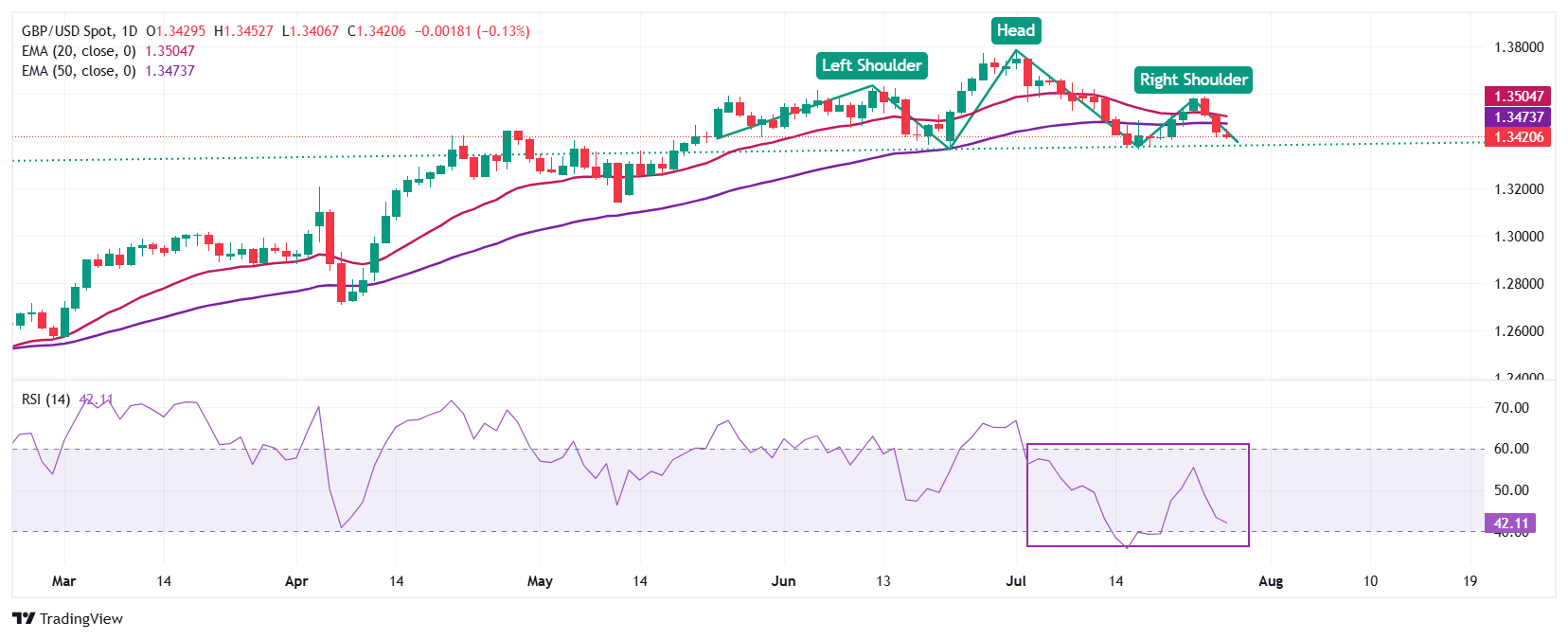
The Pound Sterling extends its downside to near 1.3400 against the US Dollar on Monday. The GBP/USD pair slides as its near-term trend remains bearish, given it trades below the 20-day and 50-day Exponential Moving Averages (EMAs), which trade around 1.3505 and 1.3474, respectively.
The formation of a Head and Shoulders (H&S) chart pattern on the daily timeframe also suggests that the outlook for the Cable is bearish. The neckline of the H&S chart pattern is plotted near 1.3413.
The 14-day Relative Strength Index (RSI) slides to near 40.00. A fresh downside move by the pair would emerge if the RSI breaks below that level.
Looking down, the May 12 low of 1.3140 will act as a key support zone. On the upside, the July 1 high around 1.3790 will act as a key barrier.