

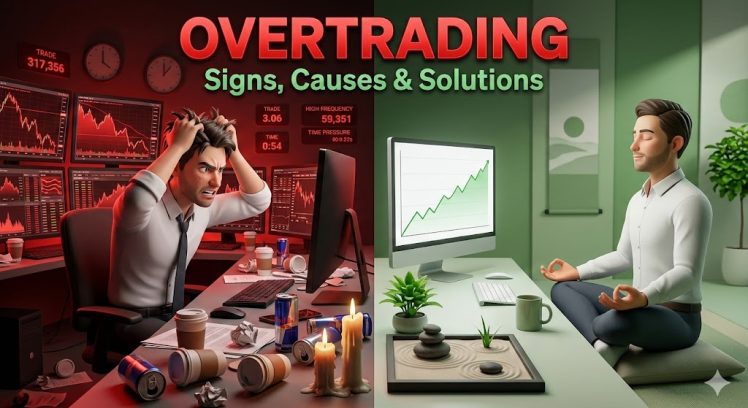


📉 Overtrading Problem:
Signs, Causes, and Solutions
🔍 What Exactly Is Overtrading?
Overtrading happens when you execute too many trades—either in frequency or size—relative to your account size and trading plan. It’s not just about quantity; it’s about trading beyond your strategy, your capital, and your emotional capacity.
“Overtrading is like eating when you’re not hungry—you’re not enjoying it, and it only makes you sick.” — Professional Trader
Two Types of Overtrading
| Type | Description | Example |
|---|---|---|
| Frequency Overtrading | Entering too many trades, often without proper setup | Taking 15 trades in a day when your strategy calls for 3 |
| Size Overtrading | Risking too much capital per trade | Putting 10% of account on one trade instead of 1-2% |
🚩 10 Signs You Are Overtrading
- ⚠️ You feel bored when not trading – and open positions just to “do something”
- ⚠️ You revenge trade after a loss, trying to immediately win back money
- ⚠️ Your trading frequency has doubled without a change in strategy
- ⚠️ You ignore your trading plan and rules regularly
- ⚠️ You check charts constantly – even during non-trading hours
- ⚠️ You feel anxious or stressed when you’re not in a trade
- ⚠️ Your position sizes have increased without proper risk calculation
- ⚠️ You’re trading during low-liquidity hours just to stay active
- ⚠️ Your win rate is dropping despite more trades
- ⚠️ Your account balance is decreasing steadily
🧠 Root Causes of Overtrading
Psychological Causes
- Greed – wanting fast money
- FOMO – fear of missing out
- Boredom – trading as entertainment
- Ego – needing to be right
- Revenge – after losses
- Addiction – dopamine rush
Practical Causes
- No trading plan – random entries
- Poor risk management – no stop losses
- Overconfidence – after winning streak
- High volatility – temptation
- Unrealistic goals – 10% weekly
📖 Real Life Example
Ahmed’s Story (True Story, Name Changed)
Ahmed started with a $1,000 account. In his first month, he made $200. Feeling invincible, he increased his trades. He started taking every signal he saw. Within two weeks, he lost $700. Desperate to recover, he revenge traded with bigger sizes. His account dropped to $0 in three days.
Moral: Overtrading doesn’t just lose money—it destroys accounts completely.
🛑 10 Proven Solutions to Stop Overtrading
Create a Trading Plan
Write down exactly when you’ll trade, how many trades per day, entry/exit rules, and max risk per trade. Follow it religiously.
Set Daily/Weekly Trade Limits
Decide: “I will take maximum 3 trades per day and 10 per week.” Once you hit the limit, stop completely.
Use a Trading Journal
Track every trade: entry, exit, emotional state, screenshots. Review weekly to spot patterns.
Strict Risk Management
Never risk more than 1-2% per trade. Use stop losses on every trade. Calculate position size based on account size.
Take Breaks
After 2-3 trades, step away for 15-30 minutes. If you lose 2-3 in a row, stop for the day.
Quality Over Quantity
One good trade following your plan is better than 10 random trades. Wait for A+ setups only.
Meditate & Control Emotions
When you feel urge to trade impulsively, take 10 deep breaths. Walk away from the screen.
Reduce Screen Time
Set specific times to check charts (e.g., London open, NY open). Don’t watch charts all day.
Find Other Hobbies
Develop non-trading activities – gym, reading, family time. Don’t let trading be your only interest.
Use Demo for Impulse Trades
If you feel overwhelming urge to take a non-plan trade, open demo account and trade there. Satisfy the urge without risking real money.
📊 Quick Reference Checklist
| Situation | What To Do |
|---|---|
| After a big loss | Close platform. Take a walk. No trades for rest of day |
| After 3 consecutive wins | Take a break. Review if you’re following plan or getting lucky |
| Feeling bored | Don’t trade. Read a book, analyze charts without entering |
| Market moving fast | Wait for pullback. Don’t chase |
| Daily limit reached | Lock your platform. Done for the day |
📌
“I printed these rules and taped them next to my screen. Every time I wanted to break one, I read them out loud. It saved me dozens of times.”
— Experienced Trader
🏆 The 3 Golden Rules
Plan your trades and trade your plan
1-2% risk per trade, always
Know when to stop – daily loss/trade limit
💭 Final Thoughts
Overtrading is not a market problem—it’s a people problem. The market doesn’t force you to take 20 trades a day. It doesn’t make you revenge trade. Those choices come from within.
The good news? Overtrading is completely curable. It takes self-awareness, discipline, and the right systems. Start with one rule today. Then add another. Track your progress. You’ll be amazed at the difference.
⏳ The best traders don’t trade the most—they trade the smartest.
⚡ Trade safe. Manage risk. Live to trade another day. ⚡
© 2026 • Written for traders who want to survive and thrive
“`