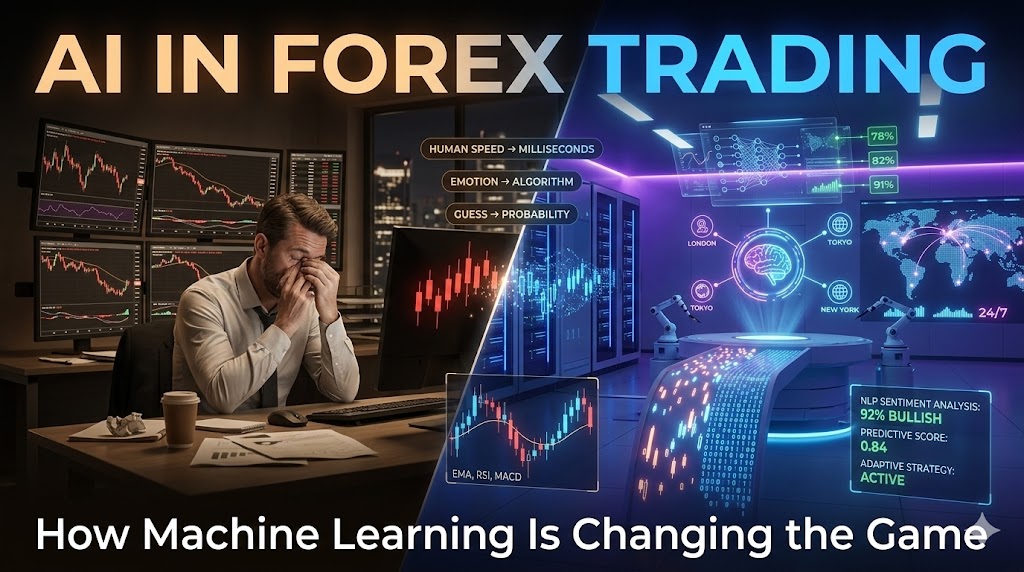





AI in Forex Trading:
How Machine Learning Is Changing the Game
What Is AI Forex Trading?
Forex AI trading uses artificial intelligence to automate and enhance trading operations that once took significant time and manual effort [citation:5]. Unlike traditional automated systems that follow rigid, pre-programmed rules, AI-powered systems can:
- Process massive amounts of market data in real-time
- Learn from historical patterns and adapt to changing conditions
- Identify complex, non-linear relationships humans might miss
- Execute trades with speed and precision beyond human capability [citation:1]
From Static Algorithms to Adaptive Intelligence
❌ Traditional EA (Expert Advisor)
- Follows fixed “if-then” rules
- Cannot adapt when markets shift
- Requires manual reprogramming
- Often fails in changing conditions [citation:4]
✅ AI-Powered System
- Learns and evolves continuously
- Detects regime changes automatically
- Adjusts strategies in real-time
- Becomes more resilient over time [citation:1]
Old-school automated forex systems run on fixed rules. Developers set up strategies based on indicators like moving averages, RSI, or Bollinger Bands. You backtest, see how it performed historically, and let it loose. But when markets shift, that static approach falls apart [citation:1]. AI turns this approach on its head.
Machine learning models crunch historical prices, volatility, macroeconomic data, and even market sentiment. Over time, the model figures out what matters and what’s just noise. Instead of sticking to a simple “if A crosses B, then buy” script, AI weighs probabilities across multiple factors [citation:1].
How AI Works in Practice
1. Natural Language Processing (NLP) for Sentiment Analysis
AI can now “read” news, social media, and central bank communications to gauge market sentiment in real-time [citation:8]. When Jerome Powell speaks, AI systems analyze his tone and content within seconds, generating trading signals before most traders finish reading the headlines [citation:8].
💡 Real Example: On August 26, 2022, during Powell’s Jackson Hole speech, AI systems detected his hawkish tone and generated USD buy signals instantly. The Dollar Index surged moments later [citation:8].
2. Predictive Analytics
Modern AI systems don’t just tell you what happened—they tell you what will likely happen next. Using neural networks and deep learning, AI assigns probability scores to potential price movements. Traders only enter when probabilities exceed a certain threshold, like 75% [citation:4].
3. Pattern Recognition
AI excels at recognizing complex chart patterns across dozens of currency pairs simultaneously. It detects formations like head and shoulders, double tops, and flag patterns without human bias, and can validate their reliability based on historical success rates [citation:3].
Key Benefits of AI Trading
24/7 Operation
AI never sleeps. It monitors markets around the clock, capturing opportunities across all time zones while you sleep [citation:5].
Emotion-Free Execution
No fear, no greed, no revenge trading. AI follows its strategy with cold precision, eliminating emotional mistakes [citation:4].
Massive Data Processing
AI analyzes millions of data points per second—far beyond human capacity—finding opportunities invisible to the naked eye [citation:4].
Adaptive Strategies
When markets shift from trending to sideways, AI detects the change and adjusts its approach automatically [citation:1].
Risks You Must Know
📉 Overfitting
AI can become too tuned to historical data, performing brilliantly in backtests but failing in live markets. This is the #1 trap in automated trading [citation:2].
🔧 Technical Failures
Software glitches, server outages, and connectivity issues can disrupt AI trading. The Knight Capital incident (2012) remains a sobering warning [citation:5].
📰 Data Quality Issues
AI is only as good as its data. Inaccurate or biased data leads to flawed decisions and significant losses [citation:5].
🎣 Black Box Problem
Some AI systems don’t explain their reasoning. Traders may lose trust or fail to understand why losses occur [citation:5].
Top AI Trading Bots in 2026
| Bot Name | Specialty | Best For |
|---|---|---|
| MetaTrader 5 AI Copilot | Prompt-to-code, real-time analysis | Programmers & manual traders [citation:10] |
| Predictive-Pulse AI | Sentiment analysis, news scanning | Fundamental traders [citation:10] |
| NeuroTrade Pro | Neural networks, low-timeframe scalping | Scalpers [citation:10] |
| Quantum-Edge Bot | Multi-currency, correlation management | Large accounts, diversification [citation:10] |
How to Start Using AI in Your Trading
“AI isn’t here to replace traders—it’s here to make us better. The winning combination is human wisdom plus machine speed.”
— Institutional trader, 2026
What’s Next: AI in 2026 and Beyond
The year 2026 marks a turning point. AI has moved from experimental to essential [citation:4]. We’re seeing:
- Personalized AI – Systems that adapt to individual trading styles and risk tolerance [citation:8]
- Hybrid models – Combining rule-based logic with machine learning feedback loops [citation:7]
- Democratized access – Retail traders now have tools once reserved for hedge funds [citation:1]
⚠️ Beware of Scams
With AI hype comes fraud. Avoid anyone promising “guaranteed profits” or “magic robots.” Legitimate AI tools are aids, not money printers [citation:4]. If it sounds too good to be true, it almost certainly is.
Final Thoughts
AI is fundamentally changing forex trading. From static algorithms that break when markets shift, we’ve moved to adaptive systems that learn and evolve. The traders who thrive in 2026 won’t be those who resist AI, nor those who blindly trust it. They’ll be the ones who understand both its power and its limitations.
Start small. Learn continuously. Keep your risk management tight. Let AI handle the heavy data lifting while you focus on strategy and oversight.
The future of forex is here—and it’s powered by intelligence, both artificial and human.
Quick Comparison: Human vs AI Trading
| Factor | Human Trader | AI Trader |
|---|---|---|
| Speed | Seconds to minutes | Milliseconds [citation:4] |
| Emotions | Fear, greed, hesitation | None [citation:5] |
| Data Processing | Limited | Millions of points/sec [citation:4] |
| Adaptability | Slow, conscious | Real-time [citation:1] |
| Fatigue | Yes | Never [citation:5] |
| Intuition | Yes (double-edged) | No |
⚡ Trade smarter, not harder ⚡
© 2026 · For traders embracing the future