




Revenge Trading:
Why It Happens and How to Stop It…
What Is Revenge Trading?
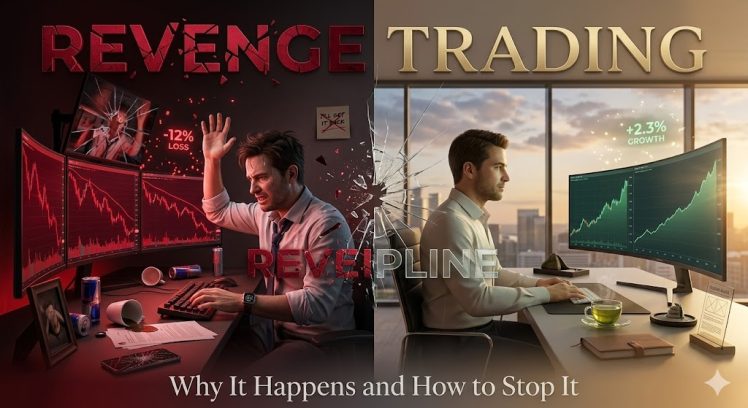
Revenge trading is the act of taking impulsive trades after a loss, driven by emotions like anger, frustration, or desperation. The goal is no longer to follow a strategy but to “get even” with the market. The market becomes an opponent you must defeat, rather than a neutral environment you navigate.
Revenge trading follows a predictable pattern:
Loss → Emotional reaction → Impulsive trade → Another loss → Stronger emotions → Larger impulsive trade → Account damage
Why Revenge Trading Happens
1. The Emotional Hijack
When you lose money, your brain triggers a fight-or-flight response. Cortisol rises. Rational thinking decreases. You enter a state where survival instinct overrides logic.
2. The Need to Be Right
Traders often tie their self-worth to being correct. A losing trade feels like personal failure. Revenge trading becomes an attempt to prove you were right all along.
3. The Illusion of Control
Taking another trade immediately feels like taking action. Doing nothing feels passive. Revenge trading gives the illusion of control, even when that control is imaginary.
4. The Gambler’s Mentality
After a loss, gamblers double down to recover. Traders do the same—increasing position size to win back money quickly, which usually leads to even larger losses.
Real Example: The Cost of Revenge
| Scenario | Disciplined Trader | Revenge Trader |
|---|---|---|
| Initial Loss | Accepts 2% loss, walks away | Gets angry, takes another trade |
| After Second Loss | Not applicable (already stopped) | Doubles position, revenge intensifies |
| End of Day | Account down 2%, ready for tomorrow | Account down 12-15%, emotional exhaustion |
5 Signs You Are Revenge Trading
- • You enter a trade immediately after a loss without analysis
- • Your position size increases after losing trades
- • You feel angry or frustrated at the market
- • You check charts constantly, hoping for a chance to recover
- • You break your own trading rules repeatedly
How to Stop Revenge Trading
1. Pre-Commit to Rules
Write your rules before trading. Include: “If I lose 2 trades in a row, I stop for the day.” Follow it without exception.
2. Impose a Cooling-Off Period
After any loss, walk away for 30 minutes. No charts. No thinking about markets. Let emotions settle.
3. Size Down After Losses
Make it a rule: after any loss, reduce position size by 50%. This protects capital and calms emotions.
4. Keep a Trading Journal
Record your emotional state before each trade. Reviewing past revenge trades helps prevent future ones.
5. Accept Losses as Normal
Even the best traders lose 40-50% of the time. Losses are not failures—they are part of the business.
6. Use Physical Reminders
Place a sticky note on your screen: “Revenge = Disaster.” It sounds simple, but it works.
“The market is a neutral observer. It doesn’t owe you anything. Revenge trading is like punching the ocean for making you wet—it only hurts your hand.”
— 20-year trading veteran
Quick Reference: What to Do Instead
| When You Feel Like Revenge Trading | Do This Instead |
|---|---|
| Anger after loss | Step away for 30 minutes |
| Urge to double down | Cut position size in half |
| Wanting immediate recovery | Remind yourself: one trade won’t fix it |
| Feeling the market is against you | Close platform for the day |
Final Thoughts
Revenge trading is not a market problem—it is an emotional problem. The market does not know you exist. It does not care about your losses. The only person who can stop revenge trading is you.
Start with one small rule: after any loss, wait 30 minutes before your next trade. Build from there. Track your progress. You will notice that the urge to revenge trade fades as you realize that discipline, not aggression, creates long-term profits.
The best revenge is consistent profitability—and that only comes from discipline.
◆ Trade with discipline, not emotion ◆
© 2026 · For traders who want to survive and thrive