



Gold Futures vs Spot Gold: Key Differences Every Trader Must Know
Introduction
Gold prices are making headlines today as markets experience significant volatility. On March 3, 2026, gold futures plunged over 4% as the dollar strengthened and US Treasury yields rose amid escalating Middle East tensions . Understanding the difference between spot gold and gold futures is essential for every trader, especially during times of market turbulence. While both instruments track the same underlying asset, they operate under fundamentally different rules that affect your trading costs, risk exposure, and potential returns. This comprehensive guide breaks down everything you need to know about trading spot gold versus gold futures in 2026.
What Is Spot Gold?
Spot gold represents the current market price at which gold can be bought or sold for immediate delivery. The spot price reflects real-time supply and demand dynamics in the global market . When news headlines report “gold prices today,” they are typically referring to the spot price.
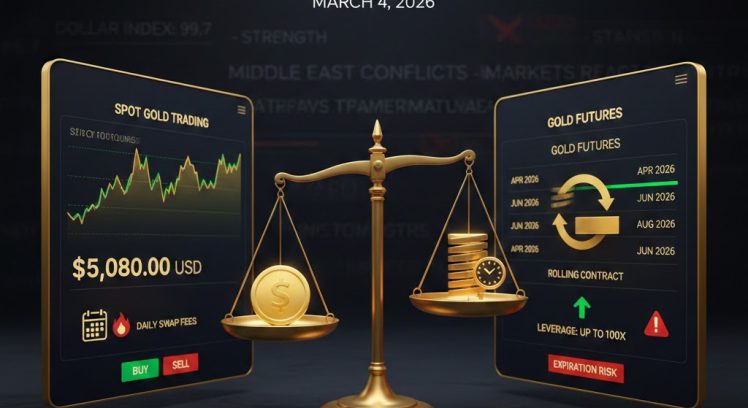
As of March 4, 2026, spot gold is trading at approximately $5,043–$5,137 per ounce, down sharply from recent highs above $5,300 .
Key Characteristics of Spot Gold Trading
Direct Price Exposure means you gain direct exposure to gold’s price movements without leverage or expiry dates. If gold rises, your position rises proportionally .
No Expiration allows you to hold positions indefinitely. There are no contracts to roll over and no time limits on your trades .
Full Payment Upfront requires you to pay the full value of your position. For example, buying one ounce at $5,043 requires $5,043 capital .
Overnight Financing Costs apply when trading on margin. Brokers charge “Tom-Next” swap fees reflecting the interest rate differential between holding dollars and gold .
Suitable for Long-Term Investors who want simple, direct gold exposure without complexity or leverage .
What Are Gold Futures?
Gold futures are standardized contracts to buy or sell a specific amount of gold at a predetermined price on a future date. These contracts trade on exchanges like COMEX and are used by institutions, hedgers, and speculators .
As of March 3, 2026, COMEX gold futures for April delivery (GCJ6) settled at $5,084.50 per ounce, down $227.10 (4.28%) from the previous session .
Key Characteristics of Gold Futures Trading
Leveraged Exposure allows you to control large positions with relatively small margin deposits. With 10x leverage, $5,000 margin controls $50,000 worth of gold .
Fixed Expiration Dates mean contracts have specific delivery months. You must close or roll positions before expiration to avoid physical delivery .
No Overnight Swap Fees means futures do not charge daily interest. However, they have their own cost structure through the futures curve .
Margin Requirements must be maintained. If the market moves against you, margin calls or liquidation can occur .
Suitable for Active Traders who focus on short-term opportunities and understand leverage risk .
Today’s Market Context: March 4, 2026
Gold markets are experiencing significant volatility driven by several factors:
| Factor | Current Situation | Impact on Gold |
|---|---|---|
| Dollar Strength | DXY near 99.7, highest since November 2025 | Stronger dollar pressures gold prices |
| US Treasury Yields | Rising for second consecutive session | Higher yields increase opportunity cost of holding non-yielding gold |
| Middle East Conflict | US-Israel-Iran war enters fourth day | Geopolitical tension typically supports safe-haven demand |
| Rate Cut Expectations | Probability of June cuts below 45% | Delayed rate cuts reduce gold’s appeal |
Spot gold fell 3.6–5.2% while gold futures dropped 3.5–4.28% in yesterday’s trading . This divergence highlights how these instruments can behave differently even during the same market event.
Spot vs Futures: The 5 Key Differences Every Trader Must Know
1. Pricing Mechanism and Structure
Spot Gold reflects the current market price based on real-time supply and demand. It is the price you see quoted on news sites and trading platforms .
Gold Futures prices incorporate expectations about future prices, interest rates, storage costs, and time value. Futures can trade at a premium or discount to spot .
In a normal market contango structure, futures trade higher than spot because sellers account for carrying costs .
2. Cost of Holding Positions
Spot Gold held on margin incurs daily swap fees (Tom-Next charges) based on the interest rate differential between the dollar and gold. These fees accumulate over time and can significantly impact long-term positions .
Gold Futures have no daily financing charges. However, they impose rollover costs. When futures contracts expire, you must sell the expiring contract and buy the next month’s contract. In contango markets, this means repeatedly selling low and buying high, creating structural drag on returns .
3. Leverage and Capital Requirements
Spot Gold typically offers leverage through CFD structures, with high leverage available but full exposure to losses. Position sizes are flexible and can be micro-sized .
Gold Futures use standardized contract sizes. A standard COMEX gold contract represents 100 troy ounces (approximately $500,000 notional value at current prices). Micro contracts represent 10 ounces, requiring lower margin but still significant capital .
4. Expiration and Rollover
Spot Gold positions never expire. You can hold them indefinitely without any action required .
Gold Futures expire monthly or quarterly. You must actively manage expirations by closing positions or rolling to future months. Failure to do so can result in physical delivery obligations .
5. Regulatory and Counterparty Structure
Spot Gold for retail traders is typically offered as CFDs through brokers. These are over-the-counter derivatives with counterparty risk .
Gold Futures trade on regulated exchanges like COMEX with centralized clearing, reducing counterparty risk but introducing exchange-specific rules .
Comparison Table:
| Feature | Spot Gold (XAU/USD) | Gold Futures (GC) |
|---|---|---|
| Current Price (March 4, 2026) | ~$5,043–$5,137 | ~$5,084 |
| Underlying Structure | OTC derivative / CFD | Exchange-traded contract |
| Primary Holding Cost | Daily swap fees (Tom-Next) | Rollover drag from contango |
| Expiration Date | None | Monthly / Quarterly |
| Capital Efficiency | High leverage, micro lots | High margin, rigid contract sizes |
| Price Determinants | Current supply/demand | Expectations + carrying costs |
| Settlement | Cash typically | Cash or physical delivery |
| Regulation | Broker-dependent | Exchange-regulated |
| Optimal Use Case | Long-term exposure, small accounts | Short-term trading, hedging |
The Hidden Costs Explained
Spot Gold: The Tom-Next Swap Fee
When you trade spot gold on margin, you are effectively borrowing dollars to hold a gold position. This creates a cost based on the interest rate differential:
-
US dollar risk-free rate: approximately 4.5%
-
Gold yield: 0%
Brokers apply a daily rollover charge at 5:00 PM EST to account for this differential, plus their markup. Holding a $100/oz rally for three months can see significant erosion from compounding swap fees .
Gold Futures: The Contango Rollover Drag
Futures markets normally trade in contango, where future prices are higher than spot due to storage, insurance, and financing costs. When you hold futures long-term, you must repeatedly roll positions forward:
-
Sell expiring contract at price X
-
Buy next month’s contract at price X + premium
-
Repeat every month
This structural “sell low, buy high” dynamic creates persistent drag on long positions .
Who Should Trade Which?
Spot Gold Is Better For:
Long-term investors seeking gold exposure without complexity. No rollover management means set-and-forget positioning.
Smaller accounts with limited capital. Micro lot sizes allow precise position sizing.
Traders who hate expiration management. Spot positions never expire, reducing administrative burden.
Those who understand swap costs and factor them into holding periods.
Gold Futures Are Better For:
Short-term traders who close positions before expiration. No swap fees benefit active traders.
Institutional hedgers needing precise exposure management.
Traders who can manage rollovers and understand contango dynamics.
Those seeking exchange regulation and centralized clearing.
The Perpetual Contract Alternative
The crypto derivatives market has introduced a third option: perpetual swaps. These instruments combine features of both spot and futures:
-
No expiration like spot
-
No rollover drag like futures
-
Transparent funding rates instead of opaque broker fees
For gold, products like XAUUSDT perpetuals allow traders to hold macro positions indefinitely without suffering contango rollover losses, using dynamic funding rates that reflect market sentiment .
Today’s Trading Implications
With gold experiencing sharp volatility, understanding instrument differences is crucial:
If you’re trading the bounce from yesterday’s 4% drop, futures offer leverage without daily swap costs for short-term positions.
If you’re building a long-term position expecting geopolitical tensions to eventually push gold higher, spot may be better despite swap costs, as futures rollover drag could accumulate over months.
Monitor the dollar and yields closely. Today’s price action shows gold remains highly sensitive to dollar strength and rate expectations .
Conclusion
Spot gold and gold futures both track the same precious metal, but they are fundamentally different trading instruments. Spot offers simplicity, no expiration, and direct exposure at the cost of daily swap fees. Futures offer leverage, exchange regulation, and no daily financing at the cost of contract rollover management and contango drag.
The right choice depends entirely on your trading style, time horizon, and capital structure. Day traders may prefer futures. Long-term investors may prefer spot. Active speculators might explore perpetual contracts that combine advantages of both.
As gold markets navigate the complex intersection of geopolitical tension, dollar strength, and shifting rate expectations in March 2026, understanding these differences isn’t academic—it’s essential for protecting your capital and maximizing returns.