








The millionaire trader mindset: cultivating habits that lead to success
Introduction: The Secret They Don’t Teach
There is a question every struggling trader asks eventually: What do the winners know that I don’t?
After years of interviewing and studying traders who have built eight-figure fortunes from nothing, a clear pattern emerges. The answer has almost nothing to do with indicators, strategies, or market timing.
The real secret is invisible. It lives between the ears. It is the mindset. The habits. The psychological framework that allows some traders to survive while others self-destruct.
Lance Breitstein, a trader who turned years of frustration into over $100 million in profits, puts it bluntly: “Traders don’t want to get rich, they want to get rich quickly.” That desire for speed destroys more accounts than any bear market ever could .
This guide reveals the ten habits that create millionaire traders. These are not theories. They are battle-tested practices from people who have done what you want to do.
The Foundation: What Success Really Looks Like
Before diving into specific habits, understand this: trading success is not glamorous.
A millionaire trader named Takashi Kotegawa, known by the trading handle BNF, turned $15,000 into $150 million. His secret was not brilliant predictions. It was relentless discipline. He spent 15 hours a day studying charts, eating simple meals to save time. He tuned out the news, skipped social media, and ignored everything except price action and his own rules.
This is the reality. Millionaire traders are not geniuses. They are ordinary people with extraordinary discipline.
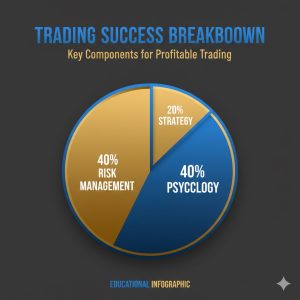
Madan Kumar, another successful trader, quantifies what most already sense intuitively: success in trading is 20% systems, 40% money management, and 40% psychology . The strategy matters, but it matters less than everything else.
: SUCCESS FORMULA
Habit One: Focus on Survival, Not Speed
The first habit of millionaire traders contradicts everything beginners believe.
They prioritize survival over profits.
Lance Breitstein warns: “If you make $10 million without discipline, it’s gone just as fast.” The traders who build lasting wealth build foundations first. They learn position sizing before chasing big wins. They master risk management before increasing share size .
Chris Sain, a consistently profitable trader, spent 2.5 years learning before he became profitable. He started making $100 a day, then scaled to $1,000, then $10,000. The process was identical at each level. Only the position size changed .
Action Step: Before your next trade, calculate exactly what you will lose if wrong. If that number makes you uncomfortable, reduce position size until it doesn’t.
Habit Two: Treat Trading Like a Video Game, Not a Battlefield
This perspective shift changed everything for one trader who made nearly a million dollars.
Most traders feel like soldiers in combat. Every bullet is aimed at them. Every loss feels like dying. This emotional intensity destroys judgment .
The alternative is to view yourself as a player sitting outside the game, controller in hand. The character on screen can die, but the player remains unaffected. Your trades are not you. Your P&L is not your identity .
Jesse Livermore, one of history’s greatest speculators, learned this lesson the hard way. His biggest failures came when he abandoned discipline and let ego override process .
Action Step: Practice detachment. After a losing trade, ask: Did I follow my rules? If yes, the trade was successful regardless of outcome.
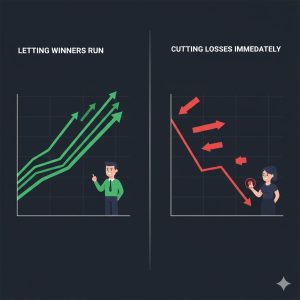
Habit Three: Let Winners Run, Kill Losers Immediately
This single habit was consistent among every wealthy trader interviewed in one study. Without exception .
Most traders do the opposite. They become impatient with winning trades, afraid profits will disappear, so they exit too early. Then they become patient with losing trades, hoping for recovery, and watch small losses become disasters .
Wealthy traders flip this script. When a trade is profitable, they give it room to breathe. When a trade moves against them, they exit immediately. No hope, no hesitation, no exceptions.
Practical Framework:
-
Define your invalidation point before entry
-
If price reaches that point, exit instantly
-
If price moves favorably, trail stops using structure
-
Never move a stop loss away from price
Action Step: Review your last ten trades. How many winners did you cut short? How many losers did you let run? The answer will tell you everything.
:WINNERS VS LOSERS
Habit Four: Make Money More Important Than Being Right
Humans crave being correct. This desire is dangerous in markets.
Wealthy traders rarely have strong opinions about direction. They read what price is doing and respond accordingly. If a trade becomes a loss, indicating they were wrong, they have no problem immediately trading in the opposite direction .
They switch sides instantly when price tells them to, even if they were “sure” the market would go the other way. Being right is not important.
Jesse Livermore’s core principle was simple: “The market is never wrong. Opinions often are.” Price action always takes precedence over narrative .
Action Step: Before entering any trade, write down the condition that would make you wrong. When that condition appears, exit without debate.
Habit Five: Create a System and Trust the Process
Millionaire traders do not chase daily results. They trust their process over weeks and months.
Takashi Kotegawa’s system was brutally simple. He looked for stocks driven down by panic rather than fundamentals. He used technical tools to time entries. When signals aligned, he acted decisively. When price reversed, he exited instantly. He repeated this thousands of times .
Chris Sain developed a “15 trades” rule. He only takes 15 high-quality setups, no matter what. This might mean three trades in two weeks. The patience transformed his results .
Ross Cameron, who turned $583 into millions, emphasizes that your most profitable patterns are already buried in your trading history. The key is mining that data relentlessly .
Action Step: Commit to one simple system for 100 trades. Judge it after 100, not after 5.
Habit Six: Journal Everything, Then Mine the Data
Ross Cameron credits his trading journal with saving his career. At a moment of desperation, when he was about to quit, his journal revealed patterns he had never noticed .
He filtered his data to discover:
-
His sweet spot was stocks between $2 and $10
-
He performed best when stocks were up at least 10%
-
Relative volume above 500% was critical
-
Stocks with float under 20 million shares worked best
-
A catalyst was almost always present
This data transformed his trading from guessing to precision.
Chris Sain writes down everything. He can tell you exactly how he did what he did, which allows him to replicate success repeatedly .
Action Step: Start a journal today. Record entry reason, exit reason, emotional state, and lessons learned. After 50 trades, analyze the data.
Habit Seven: Master the Art of Doing Nothing
This is perhaps the hardest habit for new traders.
The market is open 24 hours. Charts are always moving. The temptation to act is constant. But professional traders understand that 90% of trading work is sitting still, waiting for the right opportunity .
When you force trades, you see opportunities where none exist. FOMO takes over. Leverage expands. Losses compound. All because you couldn’t wait .
Jesse Livermore famously said: “There is a time to go long, a time to go short, and a time to go fishing.” He made his biggest money not from frequent trading, but from sitting patiently with winning positions .
Action Step: This week, try taking one less trade than you want to. If you normally take five, take four. If you normally take two, take one. Feel the discomfort. It passes.
Habit Eight: Structure Your Environment for Focus
Billionaire investors design their lives to minimize distractions. Tom Gainer’s office is as quiet as a library. Laura Garrett reserves Fridays as “creative days” with no appointments. She sometimes works from an island with no internet .
This is not luxury. This is competitive advantage.
Modern traders face constant notifications, breaking news, social media noise, and group chat chaos. Each distraction fragments attention. Each fragment costs money.
Action Step: Audit your trading environment. Remove one distraction today. One notification turned off. One app deleted. One hour of silence.
Habit Nine: Forgive Yourself and Start Fresh Daily
One trader who made nearly a million dollars describes forgiveness as the most important psychological skill .
If you carry yesterday’s losses into today’s trading, you are not trading. You are trying to heal. And the market does not care about your wounds .
The ability to wipe the slate clean each morning, to treat each day as a blank page, separates professionals from amateurs. This does not mean ignoring lessons. It means leaving emotions behind.
Action Step: Develop a pre-market ritual that clears your mind. Five deep breaths. A short walk. Three sentences of gratitude. Whatever works for you.
Habit Ten: Build a Life Beyond Trading
This final habit surprises most traders.
After interviewing dozens of billionaires, William Green discovered something unexpected. The quality of social relationships, not money, determined their daily happiness. Ed Thorpe, legendary investor, put it simply: “The time you spend with the people you love is perhaps the most important thing in life” .
Trading can consume everything. It can become identity, purpose, and meaning all wrapped together. This is dangerous. When trading is everything, every loss becomes existential.
The millionaire trader mindset includes perspective. Trading is important. It is not everything.
Action Step: Schedule one hour this week with someone you love. No phones. No trading talk. Just presence.
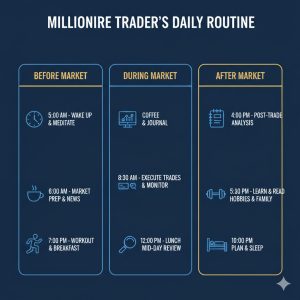
Putting It All Together: The Millionaire Trader’s Daily Routine
There is no single correct routine, but patterns emerge:
Before Market Open:
-
Review prepared watchlist
-
Check economic calendar
-
Center yourself (meditation, breathing, exercise)
-
Review trading rules
During Trading:
-
Execute only high-probability setups
-
Follow risk management without exception
-
Exit losing trades immediately
-
Let winners breathe
After Market Close:
-
Journal every trade
-
Review emotional state
-
Analyze performance data
-
Shut down completely
Weekly:
-
Review all trades
-
Identify patterns
-
Adjust approach as needed
-
Take time away from screens
:DAILY ROUTINE
The Truth About Millionaire Traders
Here is what you need to understand.
Millionaire traders are not smarter than you. They do not have secret indicators. They cannot predict the future.
What they have is discipline.
Takashi Kotegawa had no financial education. Lance Breitstein lost $37,000 in his first year. Chris Sain spent 2.5 years losing money before finding profitability .
The difference was not talent. It was persistence combined with the right habits.
You can do this. Not because it is easy. Because others have done it with less.
Your 30-Day Mindset Transformation Plan
: Awareness
-
Journal every trade
-
Notice emotional patterns
-
Identify your biggest weakness
: One Change
-
Pick one habit from this guide
-
Implement it for seven days
-
Notice the difference
: Environment
-
Remove one distraction
-
Create space for focus
-
Protect your trading time
: Integration
-
Review your month
-
Celebrate small wins
-
Plan next month’s focus
Conclusion: The Edge That Endures
There is a reason this guide contains almost no charts, no indicators, no specific strategies. Those are easy to find. They are also easy to copy.
What cannot be copied is your commitment to the process. Your willingness to sit in discomfort. Your ability to follow rules when emotions scream otherwise.
Jesse Livermore’s life teaches a final truth: markets reward discipline and punish ego relentlessly. The traders who survive and thrive into 2026 and beyond will not be those chasing speed, leverage, or prediction, but those who respect uncertainty, control risk, exercise patience, and master themselves before attempting to master the market .
In trading, survival is success. And wisdom is the ultimate edge.