









- Canada’s inflation rate is expected to rise by 1.9% annually in October.
- The Bank of Canada has cut its policy rate by 125 basis points so far this year.
- The Canadian dollar has fallen below the US dollar for many years.
Statistics Canada is set to release its October inflation report, tracked by the Consumer Price Index (CPI), on Tuesday. Inflation is expected to rise 1.9% compared to the same month last year. The CPI in September was barely changed from the previous month and rose 1.6% compared to the same period last year. The overall CPI rose 1.6% in September, falling to its lowest level in the past 12 months since February 2021 and down 0.4% from a month earlier. The financial data is important because it will affect the Canadian dollar (CAD), especially given the Bank of Canada’s current interest rates. Notably, the Bank of Canada has cut its policy rate by 125 basis points to 3.75% since the start of its easing cycle in May. The decline in the Canadian currency pushed the USD/CAD pair above 1.4100 to its highest level since May 2020.
What can we expect from Canada’s inflation rate?
Consensus among market participants appears to favour an uptick in Canadian inflation in October, although the metric should remain below the BoC’s 2.0% target. In the unlikely case that there’s an unexpected and substantial jump in prices, the underlying trend of easing inflation should keep the central bank on track with its rate-cutting strategy.
In the wake of the clear consensus that ensued the BoC’s 50-basis-point rate cut on October 23, Governor Tiff Macklem acknowledged that inflation “has come down a little faster than expected.”
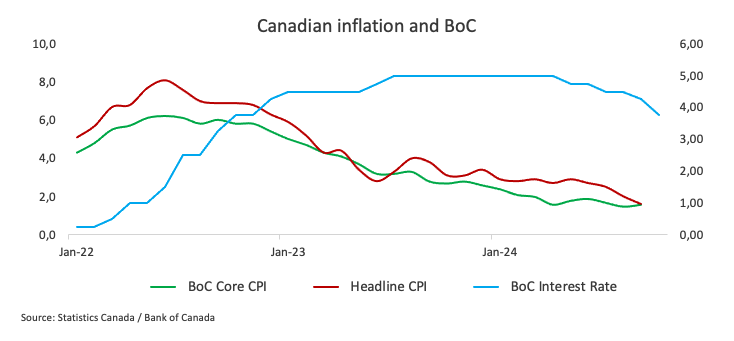
In addition, Macklem noted that headline inflation has seen a significant drop recently, attributing part of this decline to falling global Oil prices, especially in gasoline. However, he pointed out that the improvement isn’t just about volatile energy costs. He explained that core inflation – which strips out those more unpredictable factors – has also been easing gradually, much as the bank had anticipated. He added that, while shelter price inflation remains high, it has started to come down, boosting the bank’s confidence that this trend will continue in the months ahead.
Previewing the data release, Assistant Chief Economist Nathan Janzen at Royal Bank of Canada noted: “We expect some upward seasonal price moves in categories like clothing and footwear as well as travel tours. Another component to watch for is property taxes and other special charges, as this component is released only in October. The BoC‘s preferred median and trim core measures (for a better gauge of where inflation is going rather than where it’s been) both likely ticked higher in October on a three-month rolling average.”
When is the Canada CPI data due, and how could it affect USD/CAD?
Canada’s October inflation report is due on Tuesday at 1:30 p.m. ET, but the reaction of the Canadian dollar will depend on whether the data delivers a big surprise. If it meets expectations, it is unlikely to affect the Bank of Canada’s current interest rate, which is above 1.4100. The increase was almost entirely due to the strong recovery of the U.S. dollar, thanks to the so-called “Trump economy,” given the Canadian dollar’s strong value during the crisis.
FXArmy senior analyst Pablo Piovano said the Canadian dollar is likely to weaken further in the short to medium term due to the ongoing rally in the US dollar and the rise in oil prices. The next resistance level would appear at the weekly high of 1.4265 (April 21, 2020), before reaching the yearly high of 1.4667 (March 19), – Piovano added
On the downside, there is a start ahead of the interim support zone of 1.3710-1.3700, where the 55-day moving average and the 100-day simple moving average (SMA) intersect, competing with the November low at 1.3823 (Nov. 6). Both are ahead of the key 200-day SMA at 1.3663. If USD/CAD declines later, that could lead to further selling, starting at September lows of 1.3418 (September 25), Piovano said.
Economic Indicator
Consumer Price Index (MoM)
The Consumer Price Index (CPI), published monthly by Statistics Canada, represents price changes for Canadian consumers by comparing the prices of a fixed basket of goods and services. Month-over-month data compares the sales price in one month to the previous month. Generally speaking, a higher reading for the Canadian Dollar (CAD) is considered an uptrend, while a lower reading is considered a downtrend.