








Intraday trading isn’t solely for quick decision-makers—and that’s an advantage.
Because intraday trading offers:
- Abundant opportunities
- Lower competition
- Lower-risk trades
What may appear as fast thinking and quick reactions in my approach to trading is, in fact, the result of careful analysis and strategy.
Continue reading to understand how slow thinking, when paired with a structured approach, can work effectively in intraday trading.
Focus on Process, Not Speed
Slow thinkers excel at creative problem-solving and analytical reasoning. Consider the first trade of the day, which illustrates this approach:

Like a sports game played within defined boundaries, a trade is the result of thoroughly analyzing your “playing field,” guiding you on where you can and cannot trade.
Once you’re familiar with the playing field, this approach expands to include:
- Who is likely to move the price?
- Why will they move the price?
- Where will the price go?
This method simplifies the complexities of the markets, reducing them to a solid system that you can master.
Systems are designed to create consistency. Through repetition, they transform complicated processes into something easily understandable.
Anticipation, Not Reaction
By knowing when and where you plan to trade before the market opens, you avoid the mental stress of having to react impulsively.
Instead, your entries are calm and calculated because you anticipated them well in advance.
However, before you make a move, you need to understand the path your trade will take.
Price moves in different ways as it shifts between price levels, and it’s these varying paths that can cause problems such as:
- Overtrading
- Exiting at the wrong time
- Losses instead of gains
The solution, used by professional traders, is to rely on a set of “maps” for different price routes—signature trades that provide clear guidance.
Think of it like driving to your local store—a route you take regularly. Thanks to repetition, you don’t need a GPS because you know the way by heart.
Signature trades work the same way. Through repetition, you know the trade’s path instinctively.
Mental Shortcuts for Quick Action
Did you know that your brain processes visuals like colors and simple shapes 60,000 times faster than text?
A key principle in my trading strategy is basing decisions on “multiple points of evidence.” As Dr. Brett Steenbarger puts it: “If everyone engaged in evidence-based trading, there would be no overtrading.”
When you zoom out on a trade, you’ll see a reference to eight different simple shapes and colors. Each one represents a vital piece of evidence.
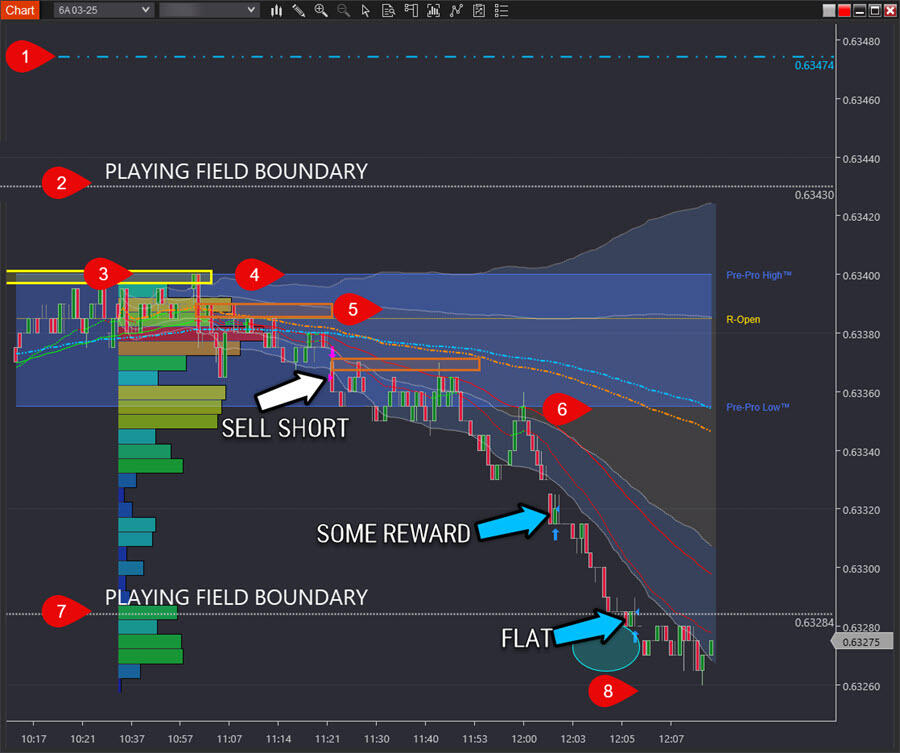
Describing the meaning of each piece of evidence in words could take several sentences. Combine all eight pieces, and you’d end up with pages of notes.
Add the additional, unnumbered evidence, and the details could fill an entire chapter of a book.
But when presented visually, you can absorb an entire chapter’s worth of information instantly.
Anyone who’s worked with me in a mentorship knows that I am precise about using the designated color key—because it’s incredibly powerful.
With a 60,000 times faster comprehension rate, think about the advantage this gives you over the many traders competing for profits.
Now, combine this with signature trades, and you have a robust trading system that doesn’t depend on fast thinking or quick reflexes.
The Kryptonite of Slow Thinkers
As a slow thinker, the one thing you must avoid is stepping out of your lane. That’s when problems arise.
In moments where the market presents something unfamiliar, you can’t think fast enough to adjust.
However, by relying on a playbook of signature trades, you shield yourself from making impulsive moves.
Your Most Valuable Asset? Energy
As you age, you might find you don’t have the same endurance you did in your 30s.
Trading, as you get older, requires a shift in mindset: time is no longer your most valuable resource—it’s energy.
By following solid principles and using a playbook of income-generating trades, you maximize your trading output efficiently.
In Conclusion
Slow thinkers often excel in reflection—a powerful tool for deep learning.
This could be during a walk with the dog, taking a break from the screens (there’s evidence telling you when to take a break).
A complex activity like trading becomes easier when you rely on smart principles, signature trades, and mental shortcuts.
Simple doesn’t mean instant. But anything you can repeat, you can master. Do you agree?
By consistently applying the framework and principles outlined, you’ll find yourself succeeding day after day, repeating your past victories.