









- The Australian dollar has weakened due to uncertainty over the Chinese economy.
- The ANZ-Roy Morgan Consumer Confidence Index held steady at 83.4 this week.
- The US dollar was supported by the Fed’s further easing of interest rate cuts.
On Tuesday, Australia’s largest market, China, reported its weakest economic data on Monday, leaving the Australian dollar weaker against the US dollar. China’s economic stimulus package announced over the weekend also failed to support the Australian dollar as investors remained uncertain about the scale of the package. Imorgan’s consumer confidence index was steady at 83.4 this week. While the figures were unchanged, longer-term trends suggest consumer confidence has remained below a record 85.0 for 89 consecutive weeks. The current reading is 1.3 points higher than the 2024 weekly average of 82.1. The market is currently pricing in an 83.6% chance of a 25 basis point rate cut in November, with no larger 50 basis point cut expected, according to the CME FedWatch tool.
Daily Summary Market Trends: Australian dollar continues to fall on China’s economic woes
- Minneapolis Fed President Neel Kashkari reassured the economy late Monday by reiterating the Fed’s data-backed approach. Reuters reported that Kashkari reiterated Fed policymakers’ view of the strength of the U.S. economy, noting that the financial crisis remains easy and the market is strong despite a recent rise in total unemployment.
- The Australian dollar could fall as the Reserve Bank of Australia (RBA) is expected to cut interest rates by 25 basis points by the end of 2024, according to a detailed report by the Commonwealth Bank of Australia. It is important for the board to review the tapering policy this year.
- The risk-sensitive AUD/USD pair might have received downward pressure due to escalating tensions in the Middle East that have sparked concerns of a broader regional conflict. According to CNN, at least four Israeli soldiers were killed, and over 60 people were injured in a drone attack in north-central Israel on Sunday.
- China’s military initiated drills in the Taiwan Strait and around Taiwan on Monday. A spokesperson for the US Department of State expressed serious concern regarding the People’s Liberation Army’s (PLA) military actions. In response, Taiwan’s Defense Ministry stated, “We will not escalate conflict in our response.”
- The National Bureau of Statistics of China reported that the country’s monthly Consumer Price Index (CPI) remained unchanged at 0% in September, down from August’s 0.4% increase. The annual inflation rate rose by 0.4%, falling short of the anticipated 0.6%. Additionally, the Producer Price Index (PPI) decreased by 2.8% year-on-year, a larger drop than the previous decline of 1.8% and exceeding expectations of a 2.5% decrease.
- On Saturday, the National People’s Congress expressed an optimistic outlook following a briefing from China’s Ministry of Finance (MoF). The MoF emphasized key priorities focused on stabilizing the property market and tackling local government debt issues. The ministry indicated that special bonds would be issued to support both bank recapitalization and efforts to stabilize the real estate sector.
- Chicago Fed President Austen Goolsby praised inflation and the economy in an interview with Bloomberg. Goolsby noted that despite the best business in September, there were no signs that the economy was overheating.
- Last week, the Reserve Bank of Australia issued a warning to committee members at its September monetary policy meeting advising them of a possible rate cut or increase. Discussions suggested that future financing would need to be tighter or looser than current levels to achieve the Board’s objectives.
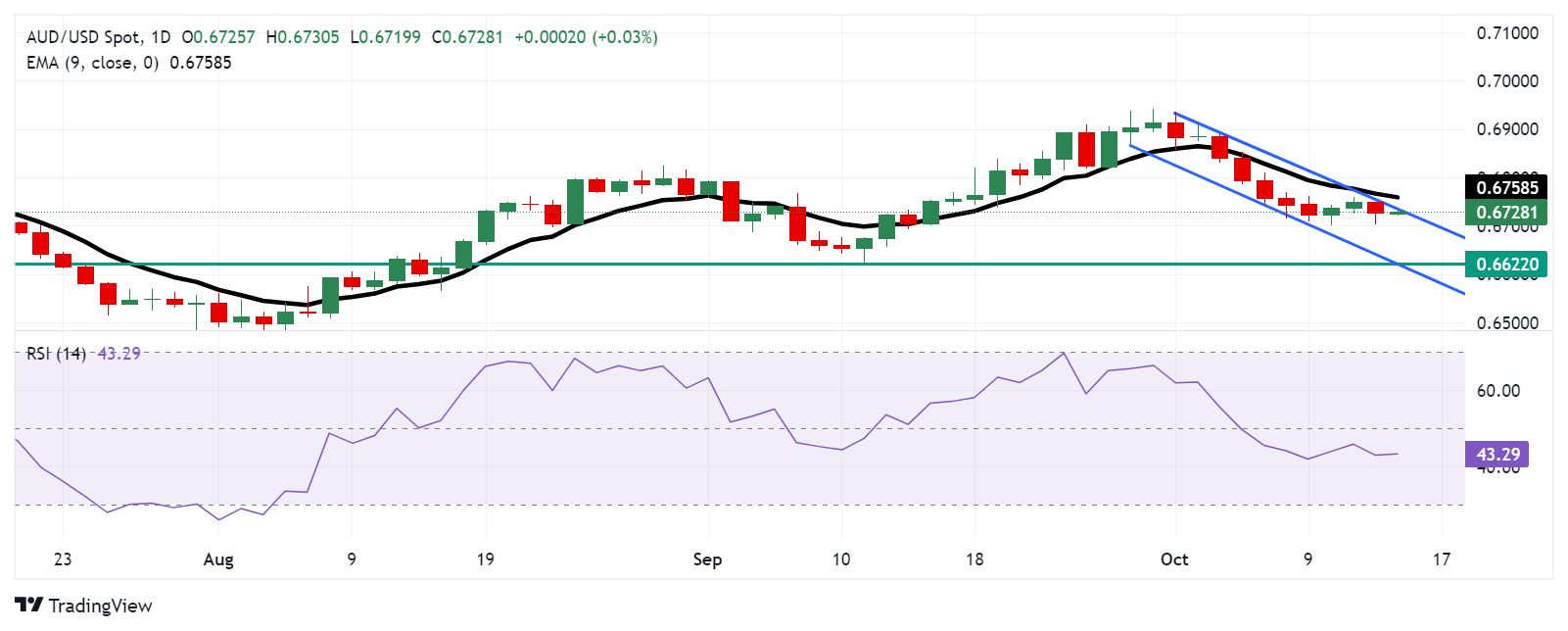
Analysis: AUD/USD still in lower range below 0.6750
AUD/USD is trading around 0.6730 on Tuesday. Analysis of the daily chart shows that the pair is testing the upper boundary of the downtrend. A successful break above this level could signal a change in momentum from bearish to bullish. However, the 14-day relative strength index (RSI) remains below 50, indicating continued bearish momentum. In this case, it could meet initial resistance near the 0.6758 level of the nine-day exponential moving average (EMA), followed by the psychological significance of 0.6800. You may encounter resistance.
AUD/USD: Daily Chart
Australian Dollar PRICE Today
The table below shows the percentage change of Australian Dollar (AUD) against listed major currencies today. Australian Dollar was the weakest against the Japanese Yen.
| USD | EUR | GBP | JPY | CAD | AUD | NZD | CHF | |
|---|---|---|---|---|---|---|---|---|
| USD | 0.14% | 0.07% | -0.04% | 0.06% | 0.16% | 0.19% | 0.03% | |
| EUR | -0.14% | -0.07% | -0.20% | -0.10% | 0.03% | 0.03% | -0.11% | |
| GBP | -0.07% | 0.07% | -0.10% | 0.00% | 0.10% | 0.10% | 0.03% | |
| JPY | 0.04% | 0.20% | 0.10% | 0.10% | 0.19% | 0.21% | 0.11% | |
| CAD | -0.06% | 0.10% | -0.01% | -0.10% | 0.09% | 0.12% | 0.04% | |
| AUD | -0.16% | -0.03% | -0.10% | -0.19% | -0.09% | 0.02% | -0.07% | |
| NZD | -0.19% | -0.03% | -0.10% | -0.21% | -0.12% | -0.02% | -0.09% | |
| CHF | -0.03% | 0.11% | -0.03% | -0.11% | -0.04% | 0.07% | 0.09% |